Introduction
The NATO Phonetic Alphabet is a list of code words used to represent the letters A to Z. In this system, speakers use a specific word assigned to each letter rather than saying a letter directly. For example, A for "Alpha", B for "Bravo", C for "Charlie", and so on.
This system was created to improve communication when radio signals are weak, there is a lot of background noise, or people have different accents. Each letter is spoken as a separate word, which makes the messages much clearer.
Today, it is primarily used by military organizations, emergency services, aviation professionals, law enforcement agencies, airlines, and businesses.
NATO Phonetic Alphabet Chart
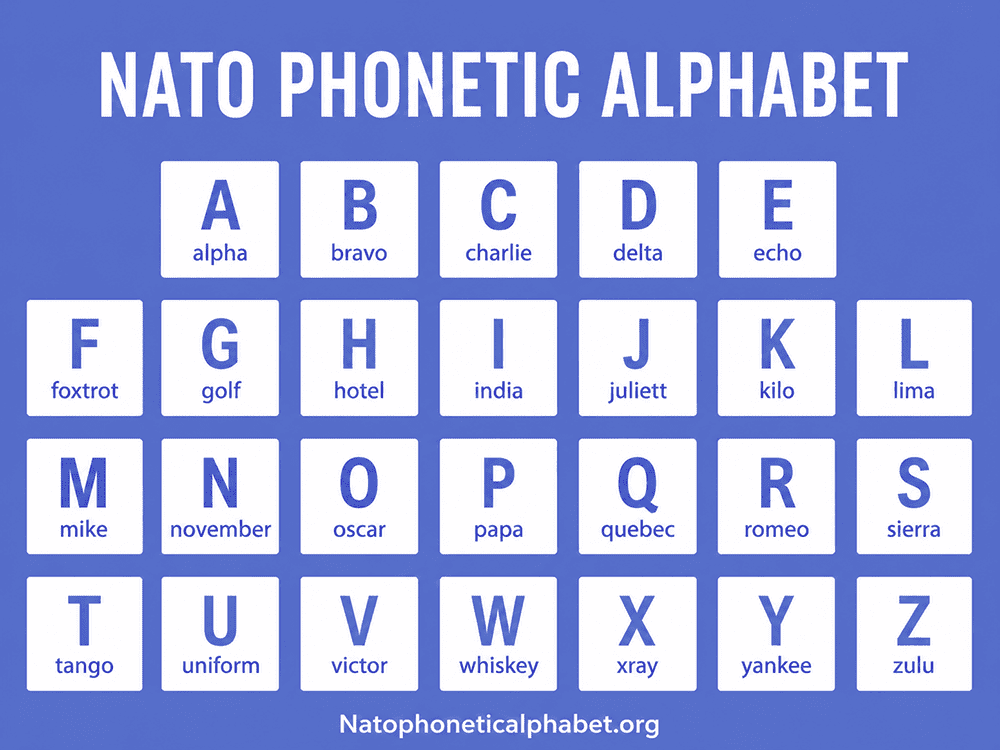
Why was this System Created?
Before the NATO system was invented, many countries used their own spelling alphabets. It often caused confusion during international communication. For example, a pilot in one country might use a different code word than an air traffic controller in another. As a result, it creates serious communication errors because of differences in language, accent, and pronunciation.
To solve this problem, experts developed a universal alphabet system that people from different countries can easily understand. The result was the International Radiotelephony Spelling Alphabet, also known as the NATO Phonetic Alphabet or Military Alphabet. It became the official standard in the 1950s and is still used worldwide.
How it Works
The concept is simple. Each letter is replaced with a unique word.
For Example:
- HD158 → "Hotel Delta One Five Eight"
- NY-717 → "November Yankee Seven One Seven"
- MARK → "Mike Alpha Romeo Kilo"
Real-World Applications
- Military Operations: Soldiers use it to communicate locations, call signs, unit names, and other critical information over radios.
- Emergency Services: Firefighters, police officers, dispatchers, and emergency medical personnel use it while exchanging important details.
- Aviation: Pilots and air traffic controllers use it to identify aircraft, spell names, and communicate flight information clearly.
- Telecommunications: Customer support agents often use it to spell names, email addresses, and account details during phone calls.
- Law Enforcement: Officers use phonetic code words when spelling names, license plates, and addresses over radio systems.
- Shipping and Communication: Ships and port authorities use it to ensure clear communication over marine radio channels.
- Amateur Radio: Ham radio operators use it to improve communication when signal quality is poor.
Frequently Asked Questions
Yes. In the United States, it's often referred to as the military alphabet because it is widely used by the U.S. Armed Forces.
- Practice Daily: Spend a few minutes each day reviewing the alphabet chart.
- Spell Your Name: Use phonetic code words whenever you spell your name. For example: Jim becomes → "Juliett India Mike".
- Read License Plates: Practice converting license plates into NATO code words while driving or walking.
- Listen to Pronunciations: Hearing the correct pronunciation repeatedly helps build long-term memory.
- Use Flashcards: It's a fastest way to memorize the alphabet.
There are 26 code words, one for each letter of the English alphabet.
Some letters sound similar when people speak over the phone or on the radio. Using code words helps prevent this type of confusion.
Although the original pronunciation was considered, the spelling "Alpha" became the accepted standard within the NATO alphabet system.
